Why Did Longteng Bridge Break? Earthquake Engineering and Visitor Responsibility
The broken bridge matters not simply because it was damaged, but because it preserves physical evidence of an earthquake. Understanding its failure explains why visitors must not climb, touch or remove even a single brick.
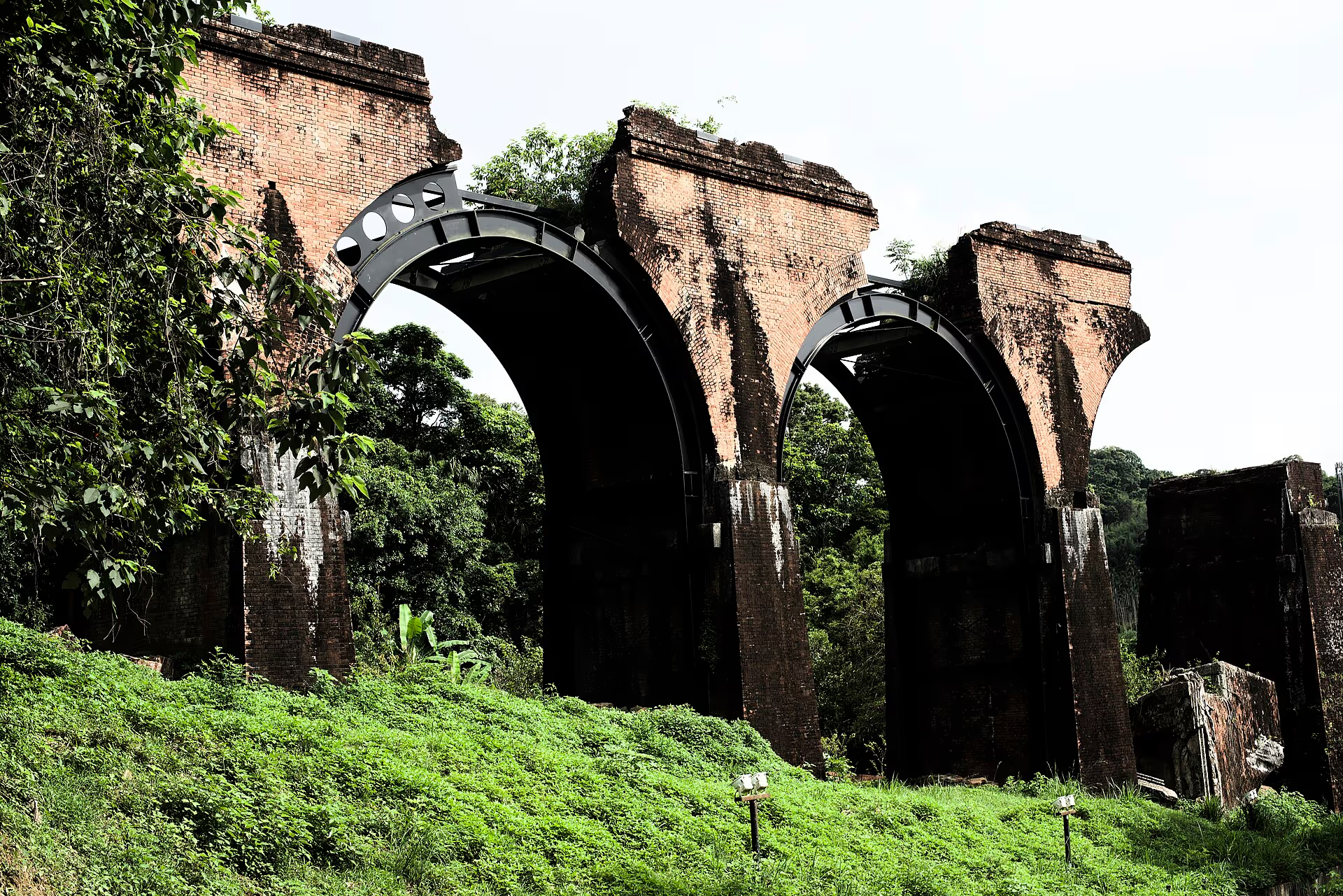
Structure
Red-brick arch bridge
Main cause of damage
1935 Guandaoshan earthquake
Heritage status
Miaoli County historic monument
Key rule
No climbing or touching
Arches resist compression
Brick arches carry compression well but struggle when their supporting piers shift sideways.
Ruins become habitats
Brick joints now host small ferns, insects and lizards.
Protection needs visitors
Without continuous walls or supervision, conservation depends on restraint.
The one-minute explanation
- A masonry arch is strong under compression but vulnerable to horizontal displacement.
- During the 1935 Guandaoshan earthquake, movement of the supports disrupted arch rings and left the bridge in broken sections.
- Instead of rebuilding the original bridge, engineers constructed a steel-girder replacement to the west, leaving two generations of structures visible today.
- The remains are both protected heritage and small habitats for hillside wildlife. Do not climb, touch or remove materials.
1. Arch mechanics: strong, but vulnerable to movement
An arch sends the load above it down through curved masonry toward supporting piers. This compression-based design can span a valley with relatively economical materials.
The limitation is that masonry arches resist tension poorly.
- When supports are stable, bricks press against each other and the structure works effectively.
- If piers shift or settle, joints can pull apart and the arch loses its compressive load path.
- Brick and mortar have limited resistance to earthquake-induced displacement, especially sideways movement.
The bridge was not simply “too weak.” Its strength depended on the ground and piers maintaining their relative positions. Strong shaking undermined that condition.
2. What happened in the 1935 Guandaoshan earthquake?
The earthquake of April 21, 1935, centered around the Sanyi–Guandaoshan area of Miaoli and commonly reported at approximately magnitude 7.1, also known as the Hsinchu–Taichung earthquake, caused severe regional damage. Yutengping Bridge stood within the affected area.
The visible failure can be understood through a simplified sequence:
- Support displacement: Strong ground movement changed pier positions.
- Loss of arch support: Movement disrupted compression and opened joints.
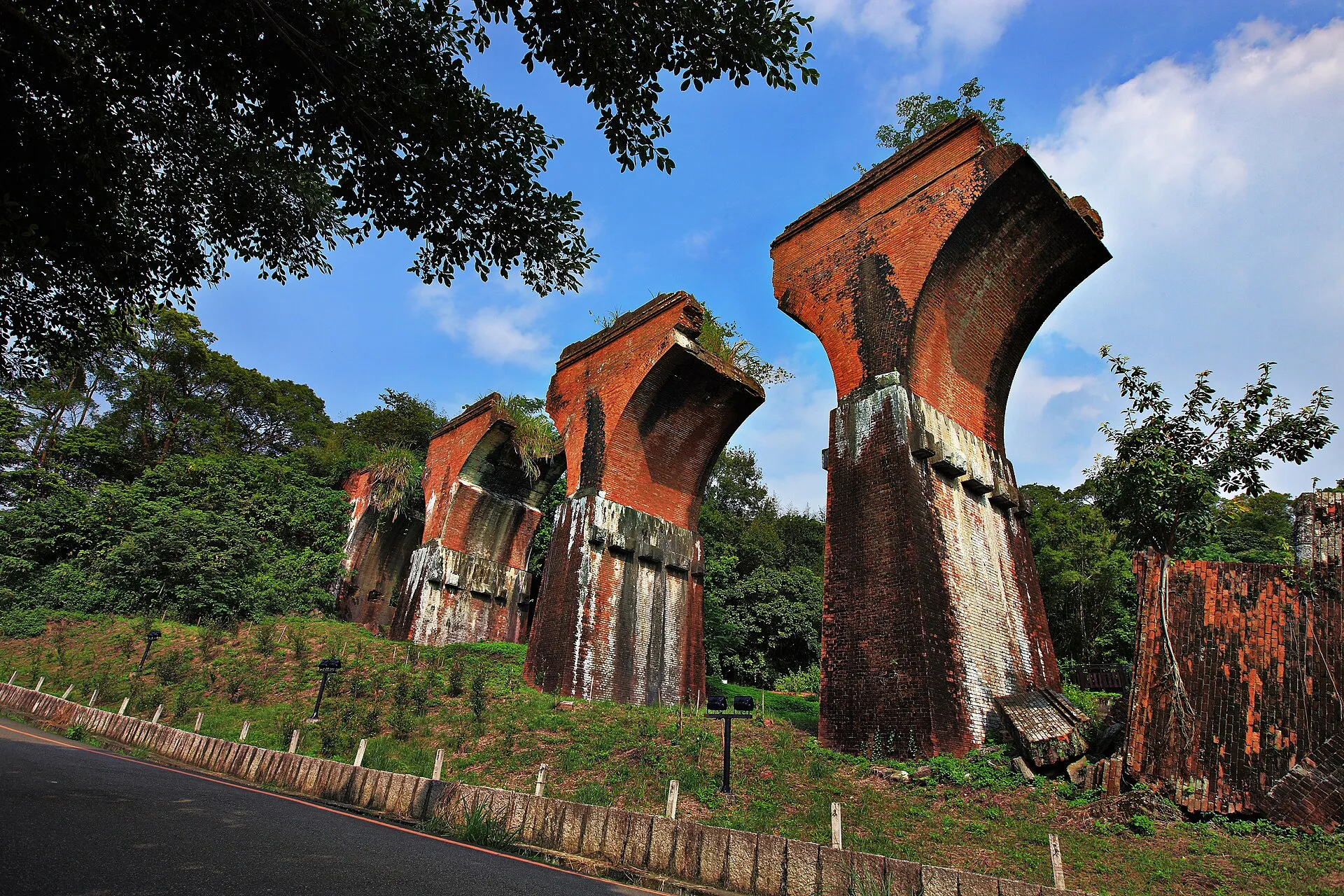
- Structural separation: Different sections suffered varying degrees of damage, leaving broken spans.
- Remaining fragments: Northern and southern parts of the bridge stayed on opposite sides of the valley.
The fractures visitors see today are physical evidence of earthquake-related structural failure. A complete reconstruction of the exact failure sequence would, however, require engineering records beyond visual inspection.
3. Why wasn’t the original bridge reconstructed?
Rail traffic had to resume, so a separate Yutengping Iron Bridge was built to the west and completed in 1938. The decision ultimately left two forms of historical value in the same valley:
- Engineering history: A brick-arch railway bridge and a later steel-girder bridge show different generations of design.
- Disaster memory: The damaged arches preserve tangible traces of a major earthquake.
The broken bridge was designated a county historic monument in 2003. Conservation therefore emphasizes limiting further deterioration, rather than recreating a working train crossing. Protective reinforcement also reflects the effect of the 1999 Jiji earthquake on the surviving structure.
4. How did a bridge ruin become wildlife habitat?
Over more than a century, weathering and dust accumulated in brick and concrete joints. The remains now offer:
- Places for ferns and mosses: Damp cracks provide attachment surfaces.
- Shelter for insects and lizards: Gaps offer cover and temperature buffering.
- Perches and feeding points for birds: The elevated structure sits within a valley habitat.
The ruin is therefore also a living microhabitat in the low hills. Removing a brick or trampling moss damages more than a historic building material.
5. Why climbing is prohibited
Historic brick and mortar continue to weather. Climbing and handling cause several problems:
- Physical damage: Weight and abrasion dislodge fragile brick faces and mortar.
- Chemical effects: Oils and sweat can alter surfaces and contribute to deterioration.
- Personal danger: The ruins were never designed as climbing equipment; nearby slopes and streambeds also lack barriers in places.
Heritage laws protect the structure, and damage or unauthorized access may have legal consequences. More importantly, there is no complete perimeter wall or continuous staff supervision. Every visitor helps determine whether the remains endure.
6. Four responsibilities for every visitor
Never climb or touch the structure. Do not stand on piers, lean against arches or use masonry as photo props. Change your camera angle or focal length instead of stepping onto the remains.
Carry all litter back out. Bins are scarce or absent along hillside routes. Take fruit peels, cigarette ends and tissues back to town. If safe, picking up one piece of existing litter helps too.
Do not disturb wildlife. Never feed monkeys or birds, capture insects or use flash photography while watching fireflies. Feeding changes animal behavior and can increase conflict; bright light interferes with firefly courtship.
Observe water and drone restrictions. Yutengping Creek lies within the upstream catchment of Liyutan Reservoir, where water play, barbecues and washing are restricted. Drone operations and commercial photography must follow applicable regulations; never fly illegally or over crowds.
7. Responding to emergencies
- Emergency numbers: Call 119 for fire and ambulance services or 110 for police. If ordinary mobile service fails, try 112.
- Bee stings or snakebites: Stay calm, limit movement and seek prompt medical care. Do not cut or suck the wound.
- Heat illness: For dizziness, nausea or cessation of sweating, get into shade, cool down and hydrate while seeking appropriate help.
- Sudden storms: At thunder, leave streambeds, exposed places and metal bridges. Do not shelter beneath large trees.
8. Our editorial approach
Popular-science writing can turn hearsay into dramatic “legends.” We follow three principles:
- Present documented history and well-supported engineering explanations as facts.
- Identify unverifiable local traditions explicitly as local accounts, not established history.
- Direct readers to operator or authority notices for changing details such as prices, schedules and openings.
For more context, see the bridge’s history and the origins of local place names.
Explore the location from different angles
Plan your visit with Google Maps
Remains of Longteng Bridge (龍騰斷橋/魚藤坪斷橋)
Miaoli County Road 49, 367 Sanyi Township, Miaoli County, Taiwan
For official tourism information see Taiwan Tourism Administration (official tourism portal) . Map pins, reviews and business information change over time; follow road signs and on-site guidance for parking and walking routes.
Read next
- Historical background History of Yutengping Broken Bridge: Earthquakes and a Red-Brick Railway Trace the bridge from its 1907 completion through the 1935 disaster, replacement iron bridge and present-day heritage status.
- Names and local stories Why Is Yutengping Called Longteng? Place Names and Local Legends Explore the origins of Yutengping, the local fish-poison vine account, the name Longteng after 1935, and the line between legend and history.
- Visitor guide First Visit to Longteng Bridge: What to See and How Long to Stay A first-timer's guide to the main viewing area, visit duration, admission, photography, and how the rail bike differs from the bridge ruins.